
The Paladins of Achaea
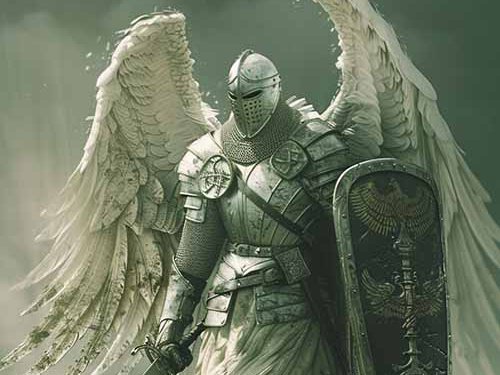
Paladins are Achaea’s holy knights. Born in the Era of Founding by Imithia’s Rite of Ending at the funeral of Pasiphae, they have carried the torch of Light and Fire for centuries. Today they serve Aurora and Deucalion, the Bloodsworn Divine of Targossas, and they fight on the front line of any war waged against Chaos, Evil, or Darkness. A Paladin doesn’t go to battle alone: their golden eagle goes with them.
Paladin lore and origin
The Paladin class is one of the most ancient on Sapience. They are the modern descendants of the Templars: warriors who, alongside the Bloodsworn Priests, formed the martial spine of the now-fallen Church of Achaea. For centuries they carried that vigil across the continent and beyond.
The Church and its seat, the city of Shallam, are gone. Both sank beneath the waves of the Eusian. But the Paladins endured. They reformed in Targossas, the Dawnspear, when the survivors of Shallam founded a new island province for the followers of Good. Today every Paladin serves Aurora, Goddess of Light, and Deucalion, the Righteous Fire. The Bloodsworn bond is sacred.
What a Paladin actually is, in plain terms: a heavily-armed warrior whose mind and body are proof against the Profane, who can call down holy fire on those who deserve it, and who fights with a golden eagle at their side. The eagle is the herald: when a Paladin approaches, the eagle’s clarion call announces them. They are the world’s bulwark against the Horror. The defenders of Creation, and its last hope against the Beyond.
This is also a class with mechanical teeth behind the flavour. Excision is one of Achaea’s signature divine combat skills, and Valour gives the Paladin a versatile toolkit of archery, eagle commands, and aggressive set-pieces. A trained Paladin is among the most dangerous melee combatants in the game.
Signature combat identity: the golden eagle and divine wrath
What sets a Paladin apart from every other warrior in Achaea is the eagle. Every Paladin bonds a golden eagle on the island of Anost within Targossas, and that eagle becomes a lifelong companion. The eagle scouts rooms from above, tracks fleeing opponents, swoops to strike at the Paladin’s command, and can even retrieve items in its talons. A skilled Paladin uses the eagle for everything: reconnaissance, mid-fight strikes, post-fight pursuit of cowards who flee.
The second half of a Paladin’s identity is divine wrath. Excision is a skill of light and fire. With Wrath, the Paladin’s sword becomes a weapon against the wicked. Pyre consigns enemies to flame. Damnation lets Creation be healed. The skill is dense with named, narrative abilities that read like scripture: Hallowed, Sustain, Banish, Confront, Decree. In combat, a Paladin is channelling holy power through their weapon while their eagle harries from the air.
Add Weaponmastery, the shared knight skill that lets the Paladin specialise in their chosen weapon school, and you have a class that is mechanically rich and thematically uncompromising. A Paladin is a holy knight in the truest sense, every ability earned through devotion and tested in battle.
The three skills of a Paladin
A Paladin commands three skill sets: Valour, Excision, and Weaponmastery. A fledgling Paladin gains Weaponmastery and Excision; Valour is granted upon embracing the class.
Signature abilities: Eagle, Battlecry, Fury
Valour has three distinct parts: the bond with a golden eagle, the art of archery, and a toolkit of aggressive combat abilities.
The eagle is Valour’s heart. Every Paladin bonds an eagle on the island of Anost in Targossas (EAGLE REQUEST), and the eagle becomes a permanent companion: scouting rooms, tracking fleeing enemies, striking on command, even retrieving items. A Paladin can also send a fellow Paladin’s eagle to safety if conditions are met (same House or city, higher rank, the eagle’s bonder offline).
Archery is the second part. A Paladin who masters Valour can assess wind direction and speed, draw longbows, crossbows, or the fabled darkbows of Hashan, and fire on opponents at range or in pursuit.
The third part is set-pieces: Battlecry to stun a target with the power of your voice, Engage to damage a cowardly opponent, Fury to temporarily raise strength, plus defensive abilities like Weathering, Resistance, and Clotting.
Abilities (31)
| Ability | Description |
|---|---|
| Eagle | Your loyal companion. |
| Weathering | Increase your ability to weather damage. |
| Seek | Order your eagle to seek out an adventurer. |
| Glance | See as your companion sees. |
| Block | Obstructing departure with your body. |
| Follow | Ever watchful. |
| Gripping | Grip your wielded items in a deathlock. |
| Barge | Barging your opponents. |
| Battlecry | Stun a target with the power of your voice. |
| Bowmanship | Use of the valued projectile weapon. |
| Quivers | Take full advantage of your quiver. |
| Wind | Further increase your accuracy through wind compensation. |
| Aiming | Increase your accuracy in shooting. |
| Sturdiness | Standing firm against attempts to move you. |
| Deliver | Small things can be salvation. |
| Resistance | Reduce the damage taken from magical attacks. |
| Crossbows | A powerful projectile weapon. |
| Clotting | Reduce the level of your bleeding. |
| Fitness | Controlling your breathing. |
| Rage | Throw off pacifying afflictions. |
| Retrieve | Secure it in the talons. |
| Startle | The steed is often an easier target. |
| Rake | Command your eagle to fall upon a foe. |
| Track | There is no hiding from the light. |
| Defend | Attempt to protect someone else with swordwork. |
| Observe | A bird’s-eye view. |
| Darkbows | Using the infamous darkbows of Hashan. |
| Nightrender | To tear the Dark asunder. |
| Engage | Damage a cowardly opponent. |
| Swiftmount | Mount or vault your steeds at increased speed. |
| Fury | Temporarily raise your strength. |
Signature abilities: Wrath, Pyre, Damnation
Excision is the divine combat art of the Paladins. It is the warriors of Light and Fire made manifest: a coruscating brilliance that breaks the Profane and excises rot from the world. The skill is built around the conviction that there will be peace only when there is no more need for swords, and that until that day, the Paladin is the one who carries them.
In combat, Excision lets the Paladin call down holy power through their blade and their armour. Wrath turns a sword against the wicked. Bladefire cleaves the shadows. Pyre consigns enemies to flame. Faith is armour that does not rust or break. Hallowed denies enemies the ability to leave a holy place. Damnation, the capstone, lets Creation be healed.
Excision is also where the Paladin’s Targossas oath bites. A Paladin who turns against the Bloodsworn Divine can be excommunicated, and Excision is the skill that gets revoked. The mechanic is intentional: divine power is a covenant, and breaking the covenant breaks the power.
Abilities (31)
| Ability | Description |
|---|---|
| Wrath | A sword against the wicked. |
| Steadfast | You will stand unmoved. |
| Denounce | Let no evil go unchallenged. |
| Faith | The armour which does not rust or break. |
| Repent | They cannot escape their sins. |
| Bladefire | Your sword shall cleave the shadows. |
| Insight | Misdirection is no refuge. |
| Dawnhand | The Lightbringer guides your hand. |
| Sustain | You will give your life for the cause. |
| Unbowed | For Creation, you stand. |
| Banish | The Anathema will not go unchallenged. |
| Crusade | Of singular focus and relentless drive. |
| Hunt | The light shines on all. |
| Hallowed | They shall not leave this holy place. |
| Scour | Cleansed in holy fire. |
| Decree | By their mandate. |
| Retribution | They will be avenged. |
| Stoke | To ever greater heights. |
| Pyre | Consign them to the flame. |
| Flare | Her radiance finds all. |
| Deliverance | Deliver one of the faithful to your side. |
| Rush | First to fight, last to fail. |
| Purify | Corruption shall be burned away. |
| Confront | The vanguard, always. |
| Martyr | With the last breath, and after. |
| Fervour | Victory is at hand. |
| Condemn | You are the judge, and you find them wanting. |
| Hellsight | The fate that awaits their deeds. |
| Bloodsworn | Bond with another via a blood oath. |
| Withdraw | The time to act is now. |
| Damnation | Let Creation be healed. |
Signature abilities: Specialise, Cleave, Disembowel
Weaponmastery is the shared knight skill that turns a Paladin into a master of melee weapons. It’s also what lets the Paladin choose a fighting style. A Weaponmaster selects one of four specialisations, each with its own weapons, signature abilities, and combat rhythm.
To pick or change a specialisation in-game: SPECIALISE IN . Changing later costs 100 lessons, whether or not you’ve embraced the class.
General abilities (all specialisations)
| Ability | Description |
|---|---|
| Swordplay | Increased mastery of the shortsword. |
| Specialise | Gain proficiency in one of the schools of weaponry. |
| Envenom | Coat a weapon in venoms. |
| Arc | Swing your blade in a controlled arc. |
Two handed
Wielding the largest weapons available: bastard swords and warhammers. Two-handed Paladins conquer through sheer overwhelming damage.
Key abilities: Carve, Hew, Devastate, Cleave.
| Ability | Description |
|---|---|
| Continuation | Shrug off afflictions like the trivialities they are. |
| Slaughter | Dispense with your opposition. |
| Overhand | Split their skulls with a mighty blow. |
| Carve | Carve through your victim’s defences. |
| Splinter | Splinter the defences protecting your opponent. |
| Perceive | Perceive the state of your opponent. |
| Underhand | Deliver a devastating rising stroke. |
| Upset | Bring them down in a tangle of limbs. |
| Hew | Deliver precision strikes against your opponent’s limbs. |
| Pulverise | Pulp your opponent’s limbs with crushing blows. |
| Distract | Distract them with a deafening shout. |
| Focus | Alter your technique. |
| Discipline | Your technique is flawless. |
| Deflect | Redirect incoming projectiles. |
| Cleave | Rend your opponent’s body in two. |
| Skullcrush | Crush their skulls. |
| Recover | A true warrior will die on his feet. |
| Devastate | Destroy their limbs utterly. |
| Brain | Put him out of his misery. |
| Overwhelm | Dispatch them with a single catastrophic blow. |
| Impale | Sink your blade into an opponent. |
| Disembowel | Tear the entrails from a target. |
Sword and shield
Using a shield for both offence and defence, armed with longswords or broadswords. The most defensive of the four specialisations.
Key abilities: Ferocity, Drive, Strike, Smash.
| Ability | Description |
|---|---|
| Rend | Rend the flesh of your foes. |
| Raze | Remove the defences that would keep your weapons from your foe. |
| Smash | Deliver a crushing blow with your shield. |
| Combination | Link your blade and shield attacks into devastating combinations. |
| Drive | Deny them of breath with a precise strike to the throat. |
| Slice | Speed is the mark of a true master. |
| Impale | Pin them to the ground with your blade. |
| Concuss | Rattle their brain with a mighty blow. |
| Trip | Send them sprawling. |
| Anticipate | You see every blow that’s coming. |
| Club | A brutal display of power. |
| Cleave | Rend your opponent’s body in two. |
| Dedication | Your dedication to victory can overcome all barriers. |
| Ferocity | Channel the ferocity of battle. |
| Strike | Unleash your ferocity against your foe. |
| Guardbreak | Exploit holes in their guard. |
| Disembowel | Tear the entrails from a target. |
Dual cutting
Two cutting weapons (scimitars or battle axes). Built around damage and venom application.
Key abilities: Duality, Lunge, Impale, Disembowel.
| Ability | Description |
|---|---|
| Predict | Predict when your blows will damage their limbs. |
| Raze | Attack the defences that would keep your weapons out. |
| Duality | The ability to wield and use two weapons simultaneously. |
| Lunge | A deep, piercing blow from an adjacent location. |
| Impale | Sink your blade into an opponent. |
| Razeslash | First penetrate his defences, then give him the sharp end. |
| Undercut | Take them down to the ground. |
| Cleave | Rend your opponent’s body in two. |
| Mastery | Through intense concentration, increase your blade mastery. |
| Concuss | Rattle skulls with a brutal blow. |
| Intimidate | Make them fear for their life. |
| Disembowel | Tear the entrails from a target. |
Dual blunt
Two blunt weapons (flails or morningstars). Built around limb destruction.
Key abilities: Momentum, Whirl, Skullcrush, Pulp.
| Ability | Description |
|---|---|
| Momentum | Strike them with ever greater power. |
| Whirl | The most basic of blunt attacks. |
| Fracture | Fracture the defences that would protect your opponent. |
| Doublewhirl | Strike twice as fast. |
| Sizeup | With the trained eye of a warrior. |
| Predict | Predict when your blows will damage their limbs. |
| Skullcrush | Crush their skulls. |
| Discipline | Your form is flawless. |
| Expend | Expend your momentum for crippling effects. |
| Assault | Unleash a terrible assault against a helpless opponent. |
| Furor | You have the high ground. |
| Pulp | End their life in a single strike. |
Paladin Houses and cities
See Achaea’s city-states for the cities where these Houses recruit.
Paladin is alignment-locked to Targossas and the Bloodsworn Divine. Two of the three Houses that accept the class are Targossan; the third is the cityless Merchants.
| House | City | Description |
|---|---|---|
| The Dawnblade | Targossas | The martial House of Targossas. The traditional Paladin home. |
| The Harbingers of Redemption | Targossas | Targossas’ House of succour and healing. Paladins who lean toward the protective and healing side of the class. |
| The Grand Merchant Collective | (cityless) | The trader House. Open to most classes; not a typical Paladin choice but available for Paladins whose path is commerce-led. |
To check current House availability in-game: HOUSE LIST PALADIN. To read about any House: HELP HOUSE .
A note on the alignment lock: a Paladin who turns against Targossas and the Bloodsworn Divine can be excommunicated and lose the ability to use Excision. The class requires roleplaying, and the mechanical consequences for breaking that roleplay are real.
How to roleplay a Paladin in Achaea
Playing a Paladin means committing to a faction. There is no neutral Paladin. You serve Good. You serve Aurora and Deucalion. You stand against Chaos, Evil, and Darkness. Your character’s life is structured around that commitment, and other players will read your character through that lens.
This is a feature, not a bug. The class carries one of the strongest roleplay identities in the game precisely because the lore is so specific. A Paladin in Sapience is recognisable, predictable, and meaningful in ways that a Runewarden or a Magi simply isn’t.
A few things worth knowing if you choose Paladin:
The Bloodsworn Divine expect things of you. Aurora and Deucalion are active Gods played by admin. Worshipping them isn’t a flavour text choice; it’s a relationship with characters who will respond to what you do. Other Targossan players, especially those high in the divine orders, will notice if your Paladin doesn’t take the worship seriously.
You will be in conflict with Mhaldor. Infernals, Apostates, the Tyrannus’ loyalists: the lore positions Targossas and Mhaldor as the central Good-Evil axis of the game. As a Paladin, you are on one side of that. Expect raids. Expect being raided. Expect long-running PvP grudges with named players.
Your eagle is part of your identity. Other Paladins know their eagles by name. So do their friends and rivals. The eagle is not a pet you summon for combat; it’s a companion that follows you into the world. Players who roleplay this aspect well get real mileage out of it.
The Dawnblade and the Harbingers play differently. The Dawnblade leans toward the soldier-paladin: martial, frontline, blade-first. The Harbingers lean toward the protector-paladin: succour, healing, the holy guardian. Both are valid. Pick the one that matches the Paladin you want to be.
If you want a class with strong RP identity, clear moral framing, and active community engagement, Paladin delivers. If you want flexibility, anonymity, or freedom from factional obligations, pick a non-factional class.
What an Achaea Paladin might look like
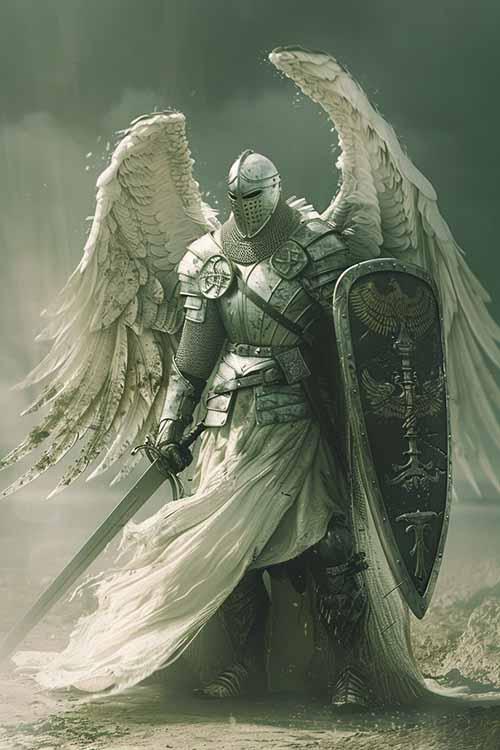
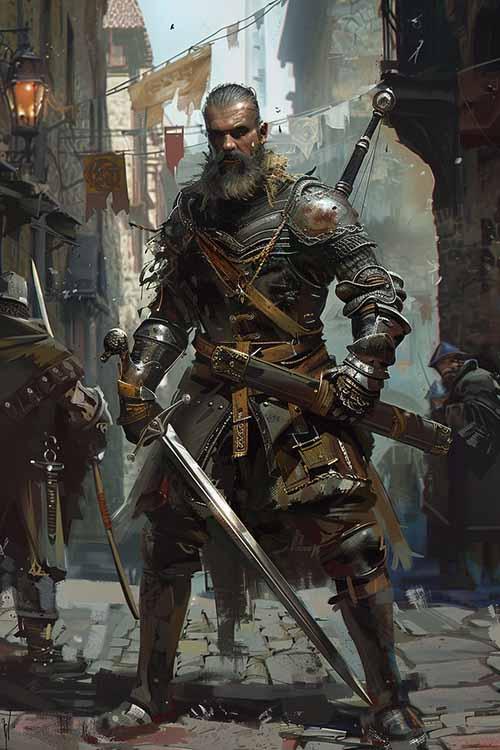
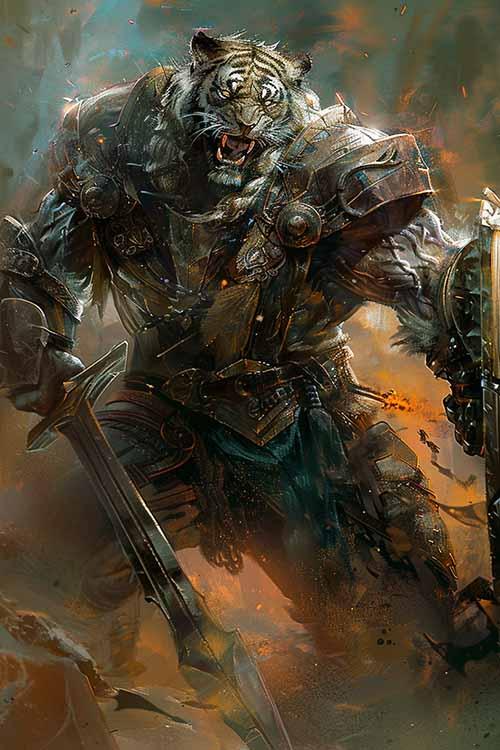
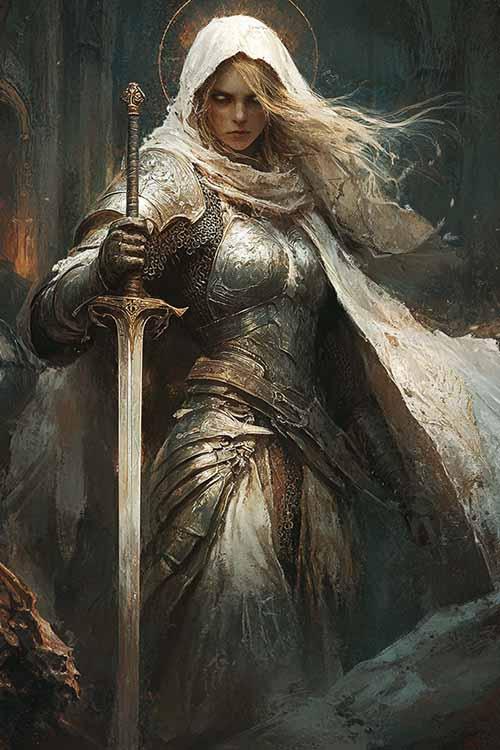
Class shapes silhouette; race shapes everything else about a character’s appearance. The art below shows what a Paladin can look like across a few of Achaea’s 14 playable races. These are illustrative examples. Any race can play a Paladin.
Other classes to consider
Three classes worth a look if Paladin is on your shortlist (or browse all 21 Achaea classes for the full comparison):
Runewarden: The Rune-Knight
Shares the Weaponmastery skill with Paladins, so the melee combat will feel similar. The difference: Runewardens are not factionally locked. They draw on Runelore and Discipline instead of Valour and Excision, and they’re welcome in most cities. Choose Runewarden if you want the knight-in-shining-armour aesthetic without the Targossas oath.
Priest: Targossas’ Bloodsworn Devotional
The other Bloodsworn class. Where the Paladin fights with sword and eagle, the Priest fights with mace, summoned angelic companion, and the Zeal scriptures. Same Targossas alignment, same factional pressure, very different combat identity. Choose Priest if the spiritual side of devotion appeals more than the martial side.
Infernal: Mhaldor’s Iron Arm of Evil
The dark mirror. Where the Paladin serves Light and Targossas, the Infernal serves Evil and Mhaldor. Shares Weaponmastery, but uses Malignity and Oppression where the Paladin uses Excision and Valour. The two classes are designed to oppose each other. Choose Infernal if you want the factional roleplay but on the Evil side of the line.
Frequently Asked Questions
Patch notes, world events, and updates from Achaea - delivered to your inbox.
Name Please enter your name. Email Please enter a valid email address.Unsubscribe at any time via the link at the bottom of any email.