
The Magi of Achaea

Magi wield the powers of the elements: primal forces that predate the dawn of time, once the province of slain Agatheis. They craft foci of power in enigmatic workshops. They form treaties with beings who dwell in the ordered Planes beyond the Prime. They master crystalline vibrations and a capacity for mass devastation that few classes match. The class is one of Achaea’s oldest combat magic traditions, and it remains one of the most versatile.
Magi lore and origin
The Magi class is ancient. Its tradition reaches back to Agatheis, a slain elemental god whose power the Magi inherited. Modern Magi continue that work in the Workshops of Artifice, crafting elemental staves and forming compacts with the Elemental Planes themselves.
The lore is terse but the implications are large. A Magi is not a wizard who memorises spells. A Magi is a practitioner whose every ability is grounded in their relationship with the elements and their physical foci. The Elemental Staff is the basis and pinnacle of an Artificer’s achievement. The crystals scattered through their workshop are tools, not props.
Combat-wise, Magi are feared on any battlefield. Their tools are described in the lore as “formidable,” and the ability list backs that up. They can alter the battlefield with bulwarks of ice, scour foes with whips of flame, blast armies with hails of lightning. Higher-order spells, the ones that require resonance with the Elemental Planes, carry real risk. Magi mastery means handling the danger of channeling them, not just knowing the spells.
This is also one of the most accessible mage classes for a new player. The class has been around long enough to accumulate decades of player-written guides. Combat is direct enough that the basic loop is teachable. The class has no factional pressure: a Magi is welcome in every city.
Signature combat identity: elemental devastation and crystalline vibration
Three things make a Magi a Magi.
The first is elemental devastation. Elementalism is the core combat skill. A trained Magi opens channels to the Elemental Realms and pulls fire, ice, lightning, earth, and water through those conduits. The capstone spells (Conflagrate, Hypothermia, Glaciate, Firestorm, Shalestorm, Emanation, Convergence) are mass-destruction abilities. They’re meant to flatten battlefields. The Magi’s role in group combat is often to be the wide-area damage dealer.
The second is crystalline vibration. Crystalism is a room-control system. A Magi refines crystals from the Master Crystal of their House, spins them in a room, and embeds vibrations in the resulting field. Some vibrations affect only the Magi. Some affect only enemies. Some affect everyone. A skilled Magi can stack vibrations to create a room that punishes intruders while protecting allies. This is one of the most distinctive combat systems in Achaea, with no good comparison to anything in other games.
The third is the elemental treaty. Artificing is the craft skill, but its higher-order content is the Elemental Treaty: a ritual compact with the Elemental Planes that lets the Magi summon Waterweirds, Djinn, Sandlings, Efreeti, Stonebacks, Breath, Mistfiends, and Ashbeasts. These creatures are bound by formal compact, not casual summons. The Magi who has built strong treaties with multiple Planes commands an army.
Together, Elementalism + Crystalism + Artificing makes Magi a three-layer combatant: direct elemental damage, persistent room-control vibrations, and summoned planar allies. There’s a reason the class shows up on most “where to start” lists for new players who want a caster.
The three skills of a Magi
A Magi commands three skill sets: Elementalism, Crystalism, and Artificing. A fledgling Magi gains Elementalism and Crystalism; Artificing is granted upon embracing the class.
Signature abilities: Channel, Light, Fortification
The crux of all which a Magi does is born in the harsh crucible of the elemental powers. Forming direct connections to those most primal of forces, the aspiring Elementalist learns magics both subtle and overt: bulwarks of ice, whips of flame, hails of lightning, shimmering reflections.
The true depths lie in higher-order spells, those workings so profoundly complex and dangerous that they require resonance with the Elemental Planes, with all the risks that lie therein.
General abilities
| Ability | Description |
|---|---|
| Channel | Open conduits to the Elemental Realms. |
| Light | Light up your surroundings. |
| Fortification | Protect your open channels from attack. |
| Scry | Locate another adventurer. |
| Resonance | The Elemental Planes are at your fingertips. |
| Erode | Destroy the defences of your opponent. |
| Binding | The magic of channel binding. |
| Deepfreeze | Cast a spell of extreme cold at your enemies. |
| Illusion | Cast an illusion of your choosing. |
| Simultaneity | Parallel channeling. |
| Stormhammer | Call down the wrath of the storm upon multiple enemies. |
| Destroy | A sliver of the Primal Fire. |
| Holocaust | Create a delayed explosion of immense power. |
| Magmasphere | A delayed eruption of magmatic fury. |
Higher Order Spells
| Ability | Description |
|---|---|
| Hypothermia | The freezing touch of Sllshya. |
| Shalestorm | A downpour of stone. |
| Firestorm | The very world shall burn at your command. |
| Glaciate | A doom of Maklak’s make. |
| Conflagrate | Summon forth a terrible conflagration. |
| Emanation | The elements unleashed. |
| Purity | Life’s water will ever run clear. |
| Convergence | Unbounded arcane might. |
Resonant Spells
| Ability | Description |
|---|---|
| Gust | Blow someone in a direction with a gust of wind. |
| Firelash | Attack with elemental fire. |
| Freeze | Chill another adventurer. |
| Geyser | Knock someone out of the trees or the sky. |
| Dehydrate | Make them vulnerable to the consuming flame. |
| Fulminate | Fry your enemies with awesome bolts of lightning. |
| Bombard | A trivial application of Air and Earth. |
| Mudslide | A sludge to send them sprawling. |
| Meteorite | To sunder that which wards. |
| Magma | Rock to boil and bubble. |
| Transfix | Mesmerize your target into inaction. |
Spells of Warding and Protection
| Ability | Description |
|---|---|
| Reflection | Create a distracting illusion of yourself. |
| Stonefist | Coat your fists with rock and punch with more power. |
| Stoneskin | Create a protective but supple layer of stone around you. |
| Chargeshield | Create a magical shield to resist electric damage. |
| Bloodboil | Boil off that which afflicts you. |
| Diamondskin | Give your skin diamond-like hardening. |
Terrain Manipulation
| Ability | Description |
|---|---|
| Firewall | Create a wall of elemental fire. |
| Fog | Conjure up obscuring fog. |
| Hellfumes | Create choking fumes in your surroundings. |
| Flood | Drown a location in water. |
| Quake | Open cracks in the ground to drain away water. |
| Icewall | Conjure up an obstructing icewall. |
| Hailstorm | Call down a hailstorm to pummel everyone else in the room. |
Signature abilities: Refine, Fold, Embed
Crystalism uses magical crystals to create vibrations. These may be single-use or, more commonly, persistent and room-based. Setting up a vibration takes three steps: refine the crystal from the Master Crystal of your House, spin it in a room (SPIN ), then embed the vibration (EMBED ). A Magi may only have one of each type of crystal spinning at once.
Some vibrations affect only you, some only your enemies, some everyone in the room. Mastery is knowing them all. To see Master Crystal remaining facets: HOUSE CRYSTALS. Personal: TOUCH CRYSTAL. Rogue magi without Master Crystal access can buy from a lady in the crystal caverns of Tasur’ke.
Abilities (37)
| Ability | Description |
|---|---|
| Refine | Refine a piece of crystal out of the Master. |
| Fold | Fold pearls into a master crystal. |
| Embed | Embed crystalline vibrations. |
| Touch | Determine how many facets you may refine. |
| Spin | Set crystals to spinning. |
| Dampen | Attempt to dampen a vibration, destroying it. |
| Vibes | See what vibrations are in a room. |
| Dissipate | Attack the mana of your enemies. |
| Palpitation | Cause small heart attacks in your enemies. |
| Heat | Fill a room with soothing warmth. |
| Alarm | Be alerted to movements of your enemies. |
| Tremors | Cause ground-shaking quakes. |
| Reverberation | Protect your vibrations against some attacks. |
| Sonicportal | Open a portal to someone. |
| Adduction | Suck those around you into your room. |
| Crystalhome | Transport yourself back to the Master Crystal. |
| Harmony | A soothing, healing vibration. |
| Creeps | Cause fear in your enemies. |
| Silence | A sound-negating vibration. |
| Ring | Extend the life of a crystalline vibration. |
| Revelation | Reveal those around you who may be concealed. |
| Muffle | Muffle your crystalline vibrations. |
| Grounding | Root yourself to the ground. |
| Oscillate | Discordant music to cause amnesia. |
| Worldvibes | The ability to see your vibes worldwide. |
| Focus | Draw your vibrations back to you. |
| Disorientation | Disorient your enemies with dizziness. |
| Energise | Suck health from your enemies and use it. |
| Stridulation | Destroy the equilibrium of your enemies. |
| Gravity | Increase the power of gravity in the room. |
| Forest | Cause a forest of sharp crystal to arise. |
| Dissonance | Cause your enemies to become dissonant. |
| Plague | Afflict your enemies with debilitating effects. |
| Lullaby | Put your enemies to sleep. |
| Retardation | Slow time in your location. |
| Cataclysm | Unleash the fury of a team of magi. |
| Destabilise | The power to destabilise crystalline vibrations is formidable indeed. |
Signature abilities: Workshop, Unweave
Though a Magi may be best known as a paragon of sorcery, calling down lightning to smite foes and altering the battlefield with motion of the hand, few give consideration to the endless hours of toil which underpin such prowess. Artificing embodies this fact.
In the Workshops of Artifice, Magi labour over their Elemental Staff, both basis and pinnacle of their achievement. Beyond foci, the most dangerous magic the Magi practice lies in the heart of the Artificer’s art: ritual compacts with the Elemental Planes themselves, the treaties that permit summoning forces beyond the lesser elementals of the past.
General
| Ability | Description |
|---|---|
| Workshop | Where it all begins. |
| Unweave | A way to unweave Talisman Pieces and gain gold. |
Foci Creation
| Ability | Description |
|---|---|
| Staff | The greatest of Elemental foci. |
| Scintilla | A crystal to channel fire. |
| Horripilation | A crystal to channel frost. |
| Lightning | A crystal to focus electricity. |
| Glacial | There is cold, then there is Cold. |
| Shock | Your foci will be positively electrifying. |
| Immolation | They will char under your power. |
| Rapidity | From force to finesse. |
Elemental Treaties
| Ability | Description |
|---|---|
| Treaties | Thus is agreement made. |
| Elementals | From word to will. |
| Waterweird | A minor servant of Sllshya. |
| Djinn | A subordinate agent of Whiirh. |
| Sandling | A diminutive denizen of Garash. |
| Efreeti | A lesser flame of Kkractle. |
| Stoneback | A hulking guardian of Earth. |
| Breath | A subtle superior of air. |
| Mistfiend | A dread minion of Sllshya. |
| Ashbeast | A harbinger of Fire. |
Magi Houses and cities
See Achaea’s city-states for the cities where these Houses recruit.
Magi is unrestricted by alignment. 16 Houses across all 6 cities plus two cityless options, the maximum for any non-factional class.
| House | City | Notes |
|---|---|---|
| The Dawnblade | Targossas | Targossan martial House. Magi here serve Light. |
| The Harbingers of Redemption | Targossas | Targossan succour House. The healer/scholar Magi home. |
| The Dread Legates | Mhaldor | Mhaldorian military House. |
| The Insidium | Mhaldor | Mhaldorian rites House. |
| The Esoteric Consortium | Ashtan | Ashtan martial House. |
| The Savants of the Wheel | Ashtan | Ashtan academic House. Strong Magi home for scholarly play. |
| The Nemesian Vanguard | Ashtan | Ashtan front-line House. |
| The Vashnarian Shield | Cyrene | Cyrene guardian House. |
| The Virtuosi | Cyrene | Cyrene artistic House. |
| The Discurean Outriders | Cyrene | Cyrene explorer/academic House. |
| The Krymenian Academy | Hashan | Hashan academic House. Another scholar’s home. |
| The Somatikos | Hashan | Hashan body-discipline House. |
| The Scions of the Ithmia | Eleusis | Eleusis forestal House. |
| The Heartwood Kin | Eleusis | Eleusis nature House. |
| The Grand Merchant Collective | (cityless) | The trader House. |
| The Carnivalis Institute of Jestering | (cityless) | The Jester-founded House. |
To check current House availability in-game: HOUSE LIST MAGI. To read about any House: HELP HOUSE .
A note for new players: Magi is one of the most newbie-friendly classes for organisations with strong academic Houses. The Savants of the Wheel (Ashtan), The Krymenian Academy (Hashan), and The Harbingers of Redemption (Targossas) all support Magi who lean scholarly.
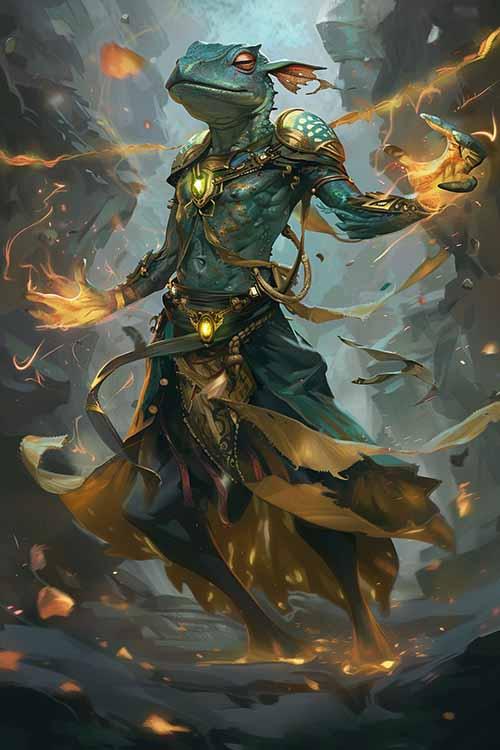
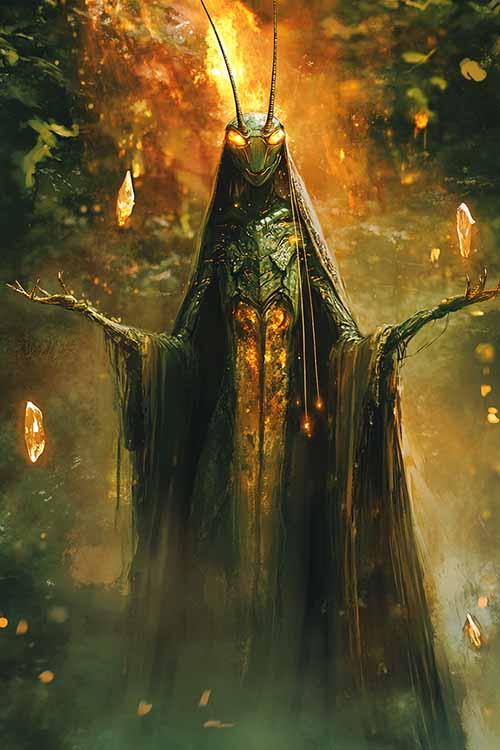
What an Achaea Magi might look like
Class shapes silhouette; race shapes everything else about a character’s appearance. The art below shows what a Magi can look like across a few of Achaea’s 14 playable races. These are illustrative examples. Any race can play a Magi.




How to roleplay a Magi in Achaea
Magi roleplay is built around two pillars: the craft and the elements.
The craft is the Workshop. Every Magi labours over their Elemental Staff for hours that don’t show up in combat logs. The staff isn’t bought; it’s made. Same with the crystals. Same with the elemental treaties. A Magi who roleplays this side of the class well treats their workshop as a real space, their staff as a real object, and the act of crafting as part of who they are. The Hashan Krymenian Academy and the Ashtan Savants of the Wheel are the obvious homes for scholar-Magi who want to lean into this.
The elements are the relationships. Sllshya (water), Whiirh (air), Maklak (cold), Garash (earth), Kkractle (fire): these are the named Elemental Powers a Magi negotiates with. A treaty isn’t a transaction; it’s a compact. Players who lean into this aspect treat the Elemental Planes as characters with personalities, allies with their own interests, and counterparts whose favour matters.
A few practical notes:
You can serve any city. Targossas, Mhaldor, Ashtan, Cyrene, Hashan, Eleusis: every city has Magi. Pick the city that fits your character; the class will work in any of them. A Targossan Magi reads as the holy scholar. A Mhaldorian Magi reads as the cold theorist of Evil. An Ashtani Magi reads as the Chaos researcher. The class is a chameleon for whichever ethos you sign up for.
Master Crystal politics matter. Your House’s Master Crystal is the source of your Crystalism kit. If you switch Houses, you switch crystals. The class has a real mechanical stake in House loyalty, even though it’s not factionally locked.
Combat is mechanically rewarding. Stacking Crystalism vibrations to control a room while channeling higher-order Elementalism spells while keeping an elemental treaty active for summons: this is layered, demanding combat. The class rewards mastery.
If you want a versatile elemental caster, an ancient combat magic tradition with active player guides, and freedom to roleplay across any city’s ethos, Magi delivers.
Other classes to consider
Three classes worth a look if Magi is on your shortlist (or browse all 21 Achaea classes for the full comparison):
Alchemist: Cauda Pavonis Scholar
The mage cousin. Where the Magi works with elemental forces and crystals, the Alchemist works with humours, transmutation, and homunculi. Same scholarly identity, different combat mechanics. Note: Alchemist is locked out of cities that accept Druid/Sentinel/Sylvan (forestal classes), so the city pool is slightly narrower.
Sylvan: The Viridian Forest Mage
The elemental-meets-nature hybrid. Sylvans use Weatherweaving (elemental weather control) alongside Groves and Propagation. The lore explicitly says Sylvans drew on both Druid and Magi knowledge. Choose Sylvan if you want elemental power but with the forestal alignment to Eleusis and Nature.
Psion: The Aldar Mind-Mage
The other ancient magic tradition. Where Magi draw on slain Agatheis’s elemental power, Psions draw on the Aldar’s psionic and weaving arts. Choose Psion if you want ancient power but with a mental rather than elemental flavour, and a smaller, more specialised community.
Frequently Asked Questions
Patch notes, world events, and updates from Achaea - delivered to your inbox.
Name Please enter your name. Email Please enter a valid email address.Unsubscribe at any time via the link at the bottom of any email.