
The Monks of Achaea
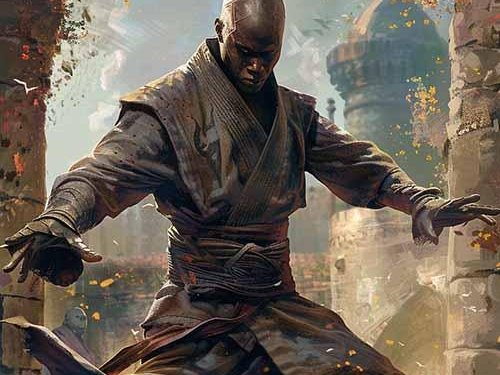
Monks unify mind, body, and spirit. Through Tekura they fight unarmed: punches, kicks, throws that break limbs and cause internal bleeding. Through Kaido they channel Kai energy to heal, harden, and unleash devastating attacks. Through Telepathy they command the mind itself. And those who master Tekura may take up Shikudo, the art of the staff, returning to the armed traditions the Grandmaster of Flowers set aside six centuries ago.
Monk lore and origin
The Monks trace their origin to an ancient order called the Sentaari, who developed the ability to use telepathy and harness Kai energy. They also mastered edgeless weapons, the staff and the cane, which let them defend without killing, while still striking mightily in defence of the peoples of the continent. During the invasion of the Tsol’teth known as the Black Wave, the Sentaari fought with these weapons.
Then, during a civil war in the ancient Seleucarian Empire, invading forces stripped the monks of their weapons to impair their ability to assist the rightful rulers. While his guildsmen were held under martial law, the Grandmaster of Flowers meditated for a month. He unveiled the unarmed art of Tekura, vowing that the monks would never again be made helpless against evil. Combined with the pre-existing Kaido and Telepathy, the Grandmaster drove the Royal Elites from the area around the monastery. Within ten years, the armed arts had fallen into disuse. Within a hundred, they had been forgotten.
In 742 AF, in the wake of murder in the very heart of the Judgement Mountain monastery, the Grandmaster again allowed use of the staff in combat. Those transcendent in Tekura could pursue Shikudo, the art of the staff. Castomira’s centuries-old embargo was lifted.
Modern Monks follow no particular set of beliefs. Some build empires. Some prefer solitary meditation. The Sentaari live on in the form of a House. The class is unrestricted by alignment and can be found in any city.
What a Monk does, in plain terms: trains body to perfection through belted Tekura (12 belts White through Black, 11 katas including Krull which unlocks Shikudo), channels mental discipline through Telepathy (mind-lock combat, suffusing/dazing/draining), and harnesses Kai energy through Kaido (Kaitrance, Kaichoke, Kaicripple). The combination makes the Monk one of the most complete combat platforms in Achaea: physical, mental, and energetic.
Signature combat identity: stance, trance, and Kai
Three things make a Monk a Monk.
The first is the stance. Tekura is the unarmed art forged by the Grandmaster of Flowers. Every Tekura attack is modified by the Monk’s current stance: Horse (the most basic), Eagle (soaring), Cat (agile and defensive), Bear (highly specialised), Rat (well-balanced), Scorpion (devastating attack), and Dragon (the superior state of mind, the capstone stance). A Monk’s combat is stance-driven: pick the wrong stance and damage drops; pick the right stance and an unarmed strike breaks a limb. The class also uses belted progression (White → Black across 12 ranks) and katas, sequences of moves demonstrated for grading.
The second is the trance. Telepathy is the skill of mental manipulation. Some abilities (marked * in the in-game lists) work on any adventurer in the room. Most require a mind lock: the Monk locks minds with a target through the Lock ability, then can Hallucinate, Confuse, Drain, Listen, Command, Crush, Daze, and finally Radiance (destroy the subject with a single blast of mental energy). The skill plays slow and patient: build the lock, then execute. The capstone, Radiance, is one of the few “single-blast kill” abilities in Achaea’s combat system.
The third is Kai energy. Kaido has two halves: bodily-control defence (Vitality, Regeneration, Restoration, Numbness, Boosting) and Kai abilities. Kai energy builds up through proximity to violent action. Once accumulated, the Monk can Kaitrance (enter a mystical trance), Kaichoke remotely, Kaicripple completely, Kaiheal, Surge with focussed power, and at the capstone Enfeeble and Deliverance (“grant your enemies release from this mortal coil”). Kaido is the engine that makes the rest of the class work: Kai-enhanced attacks scale dramatically.
Add Shikudo (the staff art unlocked by mastering Tekura and demonstrating the Krull kata) and the Monk has a complete combat identity: unarmed primary, staff secondary for masters, mental dominance, and Kai-energetic burst.
The three skills of a Monk
A Monk commands three skill sets: Tekura, Telepathy, and Kaido. A fledgling Monk possesses Tekura and Kaido; Telepathy is gained on embracing the class. Those who achieve mastery over Tekura may also pursue Shikudo, the art of the staff.
Signature abilities: Horse, Combo, Hook
Tekura was developed more than 600 years ago when the Grandmaster of Flowers, meditating for a month after his guildsmen were stripped of weapons, unveiled the unarmed art. Stance modifies the damage and speed of every Tekura attack: always be in a stance. Higher Tekura skill = higher hit and damage.
Belt progression (12 ranks): White, Grey, Yellow, Green, Blue, Orange, Red, Purple, Bronze, Silver, Gold, Black.
Katas (11): Jakata, Lisagi, Rhee, Philos, Tykorima, Opha, Nexus, Kali, Do-san, Rhythos, Krull.
To advance: DEMONSTRATE to show mastery; for grading, find a sensei (3+ belts above, or a black belt): GRADE from them advances you. Denizen tutors can grade up to silver: ASK .
Krull is the gateway kata for Shikudo. Once demonstrated for the Grandmaster, the Monk gains access to the silent grove and may take up the staff.
Abilities (33)
| Ability | Description |
|---|---|
| Horse | The most basic stance. |
| Combo | Combo attacks together. |
| Hook | A curving punch. |
| Snapkick | A straight-forward kick. |
| Jab | A straight-forward punch. |
| Eagle | Stance of the soaring eagle. |
| Sidekick | A powerful thrusting kick. |
| Uppercut | An upwards hooking punch. |
| Bodyblock | Using your body to block blows. |
| Block | Obstructing departure with your body. |
| Palmstrike | A strike with your palm to the face. |
| Hammerfist | A strike with your fists to the legs. |
| Cat | An agile, defensive stance. |
| Roundhouse | A twisting kick. |
| Evade | A block that attempts to completely avoid attacks. |
| Sweep | Attempting to sweep your opponent off his feet. |
| Bear | A highly specialised stance. |
| Slam | A throw to target the head. |
| Moonkick | A powerful, curving kick. |
| Spear | A jabbing punch with an outstretched hand. |
| Rat | A well-balanced stance. |
| Thrustkick | A kick designed to push your target away. |
| Wrench | A throw that targets already damaged limbs. |
| Axe | A slow but powerful kick. |
| Guarding | Guarding a body part and counterattacking. |
| Scorpion | A devastatingly powerful attack stance. |
| Whirlwind | The most powerful kick. |
| Bladehand | A swift strike to the side of the neck. |
| Pinch | A special and powerful block. |
| Backbreaker | The ultimate throw. |
| Jumpkick | Attack someone in an adjacent room with a flying kick. |
| Dragon | The superior state of mind. |
| Path | Switch to a new school of study. |
Shikudo (unlocked by Krull kata + Grandmaster demonstration): the staff art returned in 742 AF when the Grandmaster lifted Castomira’s centuries-old embargo. Includes 32 staff techniques: Tykonos (defensive form), Willow (speed), Oak (unbent), Gaital (deceptive form of legend), Maelstrom (a form of death), and Dispatch (capstone). See the full Shikudo ability list in your in-game HELP SHIKUDO.
Signature abilities: Sense, Lock, Glance
Telepathy is the skill of mental manipulation. Abilities split into two groups:
- **Room-target abilities (marked
*):** work on any adventurer in the room. Includes Fear*, Hallucinate*, Confuse*, Drain*, Divine*, Disrupt*, Impatience*, Epilepsy*, Stupidity*, Paralyse*, Amnesia*, Deadening*, Crush*, Strip*, Batter*. - Mind-lock abilities: require Lock first. Once locked, the Monk can Glance, Throw, Terror, Suffuse, Listen, Fullsense, Isolate, Transfer, Pacify, Empathy, Command, Mindcloak, Hypersense, Barrier, Scan, Travel, Mindnet, Daze, Sapience, Clamp, Blackout, Scythe, Radiance, Mindprints.
The capstone is Radiance: “destroy your subject with a single blast of mental energy.”
Abilities (42)
| Ability | Description |
|---|---|
| Sense | Use your telepathic powers to seek out others. |
| Lock | Focus your telepathic power to lock minds with someone. |
| Glance | Look through the eyes of your subject. |
| Telesense | Detect attempts to mind lock you or others nearby. |
| Fear | Fill your target’s mind with an irrational fear. (room-target) |
| Throw | Mentally push a subject in any direction. |
| Hallucinate | Project an illusion into the mind of your subject. (room-target) |
| Terror | Strike utter terror into the mind of your subject. |
| Confuse | Disrupt and confuse your subject. (room-target) |
| Suffuse | Suffuse the mind of your subject with mental energy. |
| Drain | Draw mana from your subject’s mind into your own. (room-target) |
| Listen | Listen to all that your subject hears. |
| Divine | Determine the health and mana levels of your subject. (room-target) |
| Fullsense | Seek out all minds within your reach. |
| Isolate | Cut remote communication off from your subject. |
| Disrupt | Destroy your opponent’s mental equilibrium. (room-target) |
| Transfer | Transfer a telepathic lock to a fellow telepath. |
| Impatience | Inability to concentrate on focused tasks. (room-target) |
| Epilepsy | Throw your victim’s nervous system into disarray. (room-target) |
| Pacify | Soothe all violent thoughts from your subject’s mind. |
| Empathy | Establishing a physical link through your telepathy. |
| Stupidity | Induce idiocy in the mind of your opponent. (room-target) |
| Command | Force a subject to do your bidding. |
| Mindcloak | Stealth telepathy. |
| Paralyse | Exert mental power to paralyse your subject. (room-target) |
| Hypersense | Hypersensitivity to telepathic activity. |
| Amnesia | Induce temporary forgetfulness into your subject. (room-target) |
| Barrier | Throw up a telepathic barrier around your subject. |
| Scan | Scan the mind of your subject. |
| Deadening | Dull your opponent’s mind. (room-target) |
| Travel | Cross great distances to your subject in a single step. |
| Mindnet | Cast a mental net about your surroundings. |
| Crush | Attack your subject with a crushing psychic attack. (room-target) |
| Daze | Render your subject extremely vulnerable to hypnosis. |
| Strip | Strip the defences from your opponent. (room-target) |
| Sapience | Instantly know your subject’s thoughts and actions. |
| Clamp | Set a telepathic mind clamp about your subject. |
| Blackout | Cause a short-lived, total blackout to your subject. |
| Scythe | Cleave their psyche asunder. |
| Batter | Devastate your opponent’s mind with an overwhelming attack. (room-target) |
| Radiance | Destroy your subject with a single blast of mental energy. |
| Mindprints | Take a mindprint of your subject. |
Signature abilities: Weathering, Vitality, Sturdiness
Kaido has two main parts. The lower abilities are an assortment of defensive abilities that rely on bodily control: automatic mana regeneration, healing limbs by force of will, dodging projectiles, resisting damage, immunity to most poisons, transmuting mana to health. The higher abilities use Kai energy, which builds up through proximity to violent actions.
Once Kai energy is accumulated, the Monk can enter the Kaitrance, Kaichoke remotely, Kaicripple a target, Kaiheal themselves, Surge with focussed power, Burst when external resources fail, Kaiboost their receptiveness, Enfeeble with a massive blast, and at the capstone Deliverance: grant enemies release from this mortal coil.
Abilities (33)
| Ability | Description |
|---|---|
| Weathering | Increase your ability to weather damage. |
| Vitality | Call upon a rush of adrenaline to heal you. |
| Sturdiness | Standing firm against attempts to move you. |
| Toughness | Increased resistance to physical attacks. |
| Deaf | Blocking out sound by force of will. |
| Hearing | Restoring your hearing. |
| Clotting | Reduce the level of your bleeding. |
| Regeneration | Regain health through strength of mind. |
| Sight | Restoring your sight. |
| Blind | Blinding yourself to prevent optical damage. |
| Resistance | Reduce the damage taken from magical attacks. |
| Nightsight | Gain the ability of infravision. |
| Fitness | Controlling your breathing. |
| Restoration | Healing damaged limbs by force of will. |
| Projectiles | Avoiding many projectiles. |
| Dodging | Avoiding attacks from the sky. |
| Constitution | Maintaining your intestinal equilibrium. |
| Splitting | Constant meditation by splitting your consciousness. |
| Breathing | Holding your breath. |
| Consciousness | The ability to stay conscious at all times. |
| Immunity | Immunity from most poisons. |
| Boosting | Increasing your rate of regeneration. |
| Transmute | Instantly convert mana into health. |
| Numbness | Delaying the effects of damage. |
| Kaitrance | Entering the mystical Kai Trance. |
| Kaichoke | Crush a victim’s windpipe remotely. |
| Kaicripple | Cripple your target completely. |
| Kaiheal | Healing yourself with Kai energy. |
| Surge | A blast of focussed power. |
| Burst | When the external will not supply. |
| Kaiboost | Increase your receptiveness to Kai energy. |
| Enfeeble | Unleash a massive blast of kai energy at your opponent. |
| Deliverance | Grant your enemies release from this mortal coil. |
Tekura Monk-specific specialisation:
| Ability | Description |
|---|---|
| Transition | Push yourself beyond your limits. |
Monk Houses and cities
See Achaea’s city-states for the cities where these Houses recruit.
Monk is unrestricted by alignment. 16 Houses, same wide acceptance as Bard, Magi, Serpent.
| House | City | Notes |
|---|---|---|
| The Somatikos | Hashan | Hashan body-discipline House. The most on-brand home for Monks, given Tekura and Kaido’s body-perfection focus. |
| The Krymenian Academy | Hashan | Hashan academic House. Strong for Monks who lean toward Telepathy scholarship. |
| The Vashnarian Shield | Cyrene | Cyrene guardian House. |
| The Virtuosi | Cyrene | Cyrene artistic House. |
| The Discurean Outriders | Cyrene | Cyrene explorer/academic House. |
| The Dawnblade | Targossas | Targossan martial House. Monks who serve Light. |
| The Harbingers of Redemption | Targossas | Targossan succour House. |
| The Dread Legates | Mhaldor | Mhaldorian military House. |
| The Insidium | Mhaldor | Mhaldorian rites House. |
| The Esoteric Consortium | Ashtan | Ashtan martial House. |
| The Savants of the Wheel | Ashtan | Ashtan academic House. |
| The Nemesian Vanguard | Ashtan | Ashtan front-line House. |
| The Scions of the Ithmia | Eleusis | Eleusis forestal House. |
| The Heartwood Kin | Eleusis | Eleusis nature House. |
| The Grand Merchant Collective | (cityless) | The trader House. |
| The Carnivalis Institute of Jestering | (cityless) | The Jester-founded House. |
To check current House availability in-game: HOUSE LIST MONK.
A note on the Sentaari: The lore notes that the Sentaari, the ancient order that originated the Monk tradition, live on in the form of a House. Player Monks may trace their training to the modern Sentaari lineage even if they don’t belong to a House named directly for it.
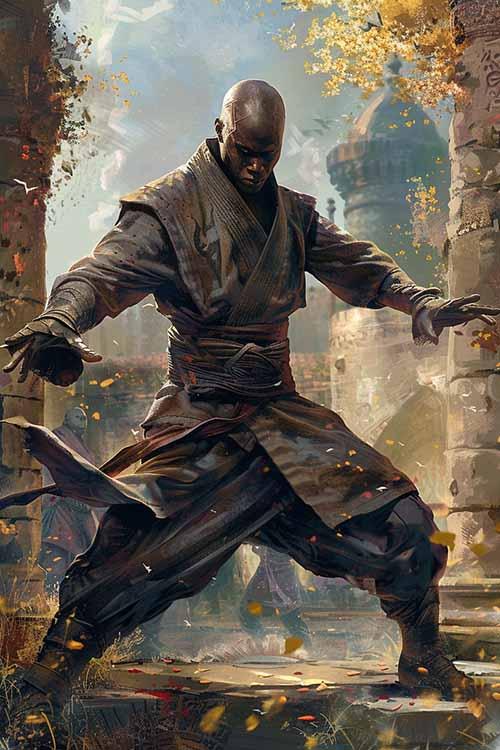
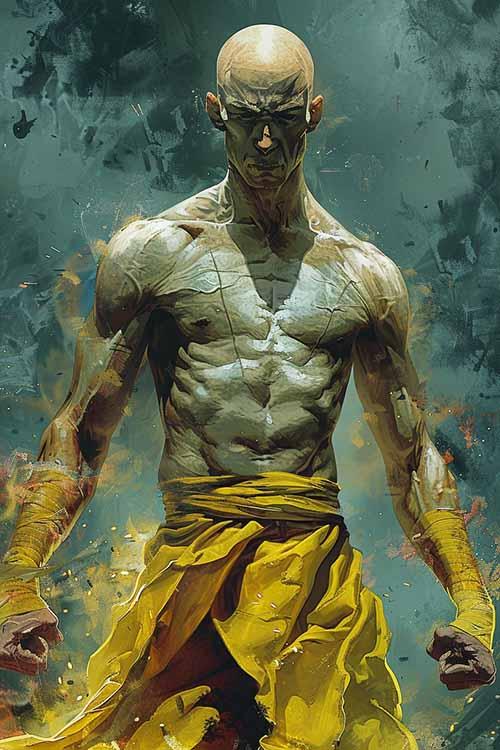
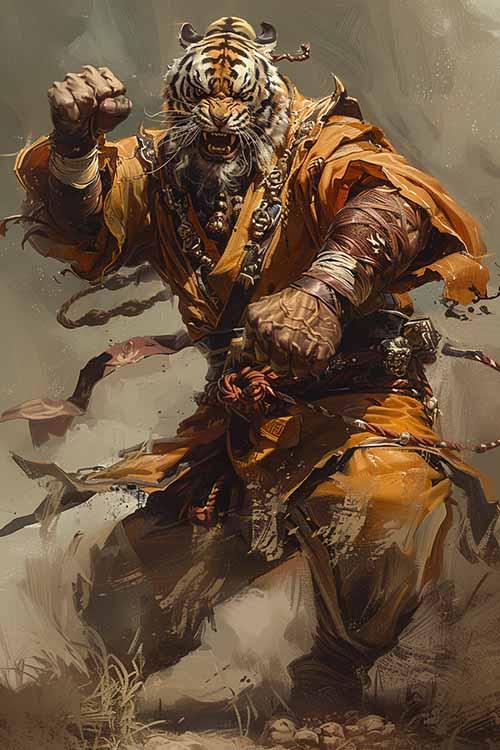
What an Achaea Monk might look like
Class shapes silhouette; race shapes everything else about a character’s appearance. The art below shows what a Monk can look like across three of Achaea’s 14 playable races. These are illustrative examples. Any race can play a Monk.
How to roleplay a Monk in Achaea
A Monk’s identity is discipline. Your character has trained their body and mind to a perfection most adventurers never approach. The class lore is explicit: mind, body, and spirit are unified into an indomitable force. Roleplay this.
Three things make Monk roleplay distinct:
Your belt is your character’s progress. Belts (White → Black) and katas are visible markers of how far your Monk has come. Players who reference their belt rank in roleplay, and treat each new belt as a meaningful step, get the strongest Monk character moments. The path from white to black is years of in-character training.
Your stance is part of you. A Monk who fights only in Horse stance reads differently than one who flows between Dragon, Scorpion, and Cat as the fight evolves. The stances are mechanical AND character. A Dragon-stance Monk in combat is in “the superior state of mind” per the lore, that’s a roleplay moment.
You can take any city. Like Magi and Bard, the Monk has no factional pressure. Your character serves whatever cause aligns with their training. A Targossan Monk reads as the disciplined holy warrior. A Mhaldorian Monk reads as the cold theorist of strength. A Hashani Monk reads as the scholar of mind and body. Pick the city; the class adapts.
A few practical notes:
The Somatikos (Hashan) is the natural home. Body-discipline focus matches Tekura and Kaido perfectly. The Krymenian Academy (Hashan) is the secondary home for Monks who lean toward Telepathy scholarship.
Combat has the highest skill ceiling alongside Serpent. Stance management, Kai energy accumulation, mind-lock building, and Tekura attack chaining is a lot to coordinate. The class rewards years of practice.
The Krull kata is a milestone. If your character pursues Shikudo (the staff art), the Krull kata demonstration is a significant in-character moment. Players who play that as a real event get strong character beats out of it: preparation, the demonstration, the staff selection at the silent grove.
If you want a class with the deepest discipline identity in Achaea, three-layer combat through body-mind-energy, and the visible progression of belts and katas, Monk delivers.
Other classes to consider
Three classes worth a look if Monk is on your shortlist (or browse all 21 Achaea classes for the full comparison):
Blademaster: The Named-Blade Tradition
The mind-body sword counterpart. Both classes train their bodies as instruments. Where the Monk fights unarmed (Tekura) or with a staff (Shikudo), the Blademaster fights with a uniquely named blade and the Shin trance. Same alignment flexibility, similar mechanical demands. Choose Blademaster if you want the sword-precision combat instead of unarmed mastery.
Psion: The Aldar Mind-Mage
The other mental-might class. Where the Monk’s Telepathy locks minds and crushes psyches, the Psion’s Psionics culminates in Foresight, piercing time’s veil to see an enemy’s next move. Different ancient lineage (Aldar vs. Sentaari), similar appeal to cerebral combat players.
Bard: Achaea’s Rapier-and-Song
The other performance/discipline class. Both classes treat training as an art form. Where the Monk channels training inward (Kai, stance, kata), the Bard channels training outward (song, saga, rapier). Same flexibility (16 Houses, no factional lock). Choose Bard if outward performance appeals more than inward discipline.
Frequently Asked Questions
Patch notes, world events, and updates from Achaea - delivered to your inbox.
Name Please enter your name. Email Please enter a valid email address.Unsubscribe at any time via the link at the bottom of any email.