
Patch notes, world events, and updates from Achaea — delivered to your inbox.
Name Please enter your name. Email Please enter a valid email address.Unsubscribe at any time via the link at the bottom of any email.
Achaea Divine Orders: Serving the Gods
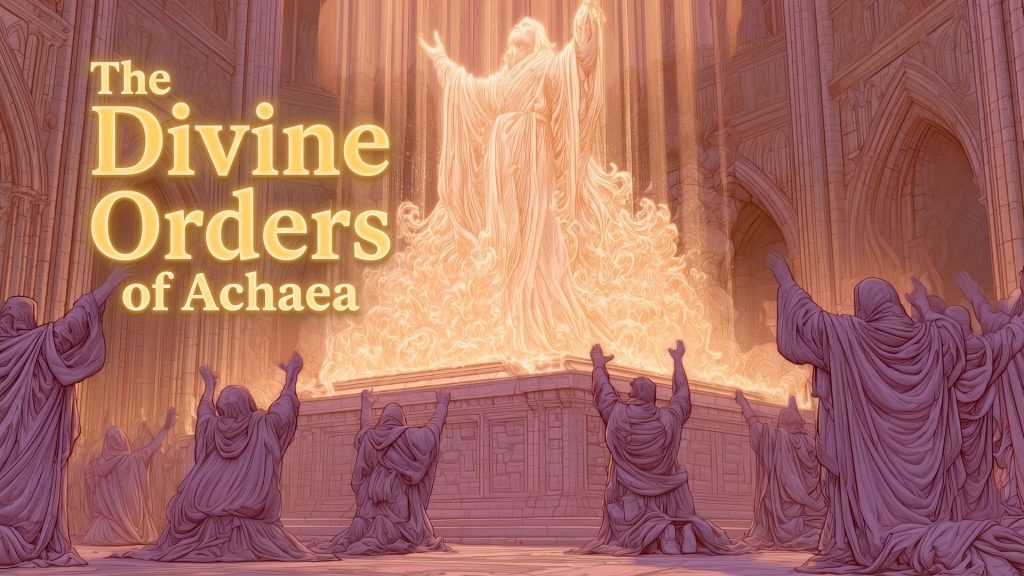
A Divine Order in Achaea is the formal body of a god’s most loyal followers, the players who serve a deity directly instead of just honouring them. Achaea’s gods form a Pantheon, and each one stands for something specific: war, justice, ruin, honour, or some idea darker still. A god’s ethos shapes the cities, the conflicts, and the people who serve it. The most devoted Achaeans go further than prayer. They join a god’s Divine Order and become that deity’s hand in the world.
This page explains what a Divine Order is, how you join one, and what Order members actually do. For the full roster of deities, see the Gods of Achaea. If a god’s cause sounds like your way into the game, start here.
The gods behind Achaea’s Divine Orders
Achaea’s religion centres on a Pantheon of gods, and each one is a distinct power with their own domain and purpose. War belongs to one. Justice, cunning, or the slow spread of corruption falls to others. These gods aren’t interchangeable, and a deity’s ethos tells you what it rewards in its followers and what it will not tolerate.
Because every god stands for something specific, the Pantheon maps onto the moral fault lines of the world. The gods sit somewhere on the line between good and evil, and their followers carry that alignment into the cities, the Houses, and the conflicts they take part in. Religion in Achaea isn’t a side menu. It runs through the politics and the roleplay that drive the game.
What a Divine Order is
A Divine Order is the formal body of a god’s most loyal followers. When you join one, you formally declare your allegiance to that deity and pledge yourself to their cause. Membership marks you as a representative of that god on the world stage. Your actions reflect on them, and theirs reflect on you.
Not every god accepts followers, so the gods who keep Orders are the ones you can actually serve. Once you’re in, your character answers to a higher power, and that power has opinions.
How rank works inside an Order
An Order isn’t flat. It runs on ten ranks, and each rank carries its own privileges and responsibilities. Devotees who prove themselves climb that ladder, taking on a louder voice in how their god’s will gets carried out. It’s one of the deepest roleplay paths in the game, because the higher you rise, the more your deity expects of you.
What a Divine Order’s members do for their god
Serving a god is active, not ceremonial. Members of a Divine Order shape the world in their deity’s name, and the work tends to fall into two arenas: shrines on the Prime Material Plane, and open battle on Nishnatoba.
Raising and defending shrines
Order members raise shrines in their god’s honour. A shrine is the physical presence of a deity in the world: a foothold where followers offer divine essence and evoke the god’s power. Shrines are worth defending, because rival Orders push back. Achaea’s history records open Shrine Wars, and the contest over whose shrines stand where still runs today. Hold ground for your god, or watch a rival faith take it.
Fighting on the battleplane of Nishnatoba
When devotion turns to open conflict, the faithful head to the battleplane of Nishnatoba. Every god keeps a master shrine there, and followers reach it during crusades launched from the Prime Material Plane. Nishnatoba runs on unrestricted combat rules, so you can be killed at any time, for any reason, without retribution. It’s where Orders test themselves against one another directly, and where proving your worth to a god stops being abstract.
How Achaea religion ties into the rest of the game
The gods don’t sit apart from the rest of Achaea. Their alignments connect to the city-states, where good-aligned and evil-aligned communities draw on different divine sympathies. The evil city of Mhaldor, for example, was built around a creed that mirrors the darker gods. Your faith colours which city-states you’ll feel at home in and which you’ll set yourself against.
It feeds the roleplay layer too. A character’s religion gives them a worldview, a set of loyalties, and a reason to care about events far beyond their own story. For players who want their choices to carry weight inside a living world, devotion to an Achaea god is one of the surest ways to find it. If you’re brand new, the newbie guide will get you grounded first, and faith can come once you’ve found your feet.
Pick a god whose aims match your own, climb their Order, and you stop being a face in the crowd. You become part of how the divine makes itself felt in Achaea. See where it fits in the wider game features hub.