
What Are MUDs? A Look Inside One That Has Run Since 1997
A MUD, short for Multi-User Dungeon, is a text-based multiplayer online game where everyone shares one persistent world, types commands to act, and reads the results as written descriptions. MUDs are the original massively multiplayer online RPGs. They arrived roughly two decades before the first graphical MMO.
That is the category. It tells you nothing about what a MUD game is like once a few thousand people have spent decades pulling at it. Achaea opened in September 1997, the same month as Ultima Online, and it has never closed for a redesign. So instead of describing the genre from a distance, this page shows you one from the inside.
What a MUD game looks like on your screen
Nothing gets rendered, so the world arrives as prose. You walk into a room and the game tells you where you are and what is in there with you.
Ashtan, the Grand Aetherway.
A wide boulevard of black stone runs north toward the harbour. Its
gutters still run from the morning's rain. Shuttered stalls line
both sides, and the water has left their awnings sagging.
You see a grizzled town crier here.
There are 3 obvious exits: north, east and southwest.
Type north and the next room arrives. Type look at crier and you get a paragraph about the crier: what he is wearing, what he is shouting about, whether he looks like anyone has paid him recently. Once a handful of verbs stop feeling like a foreign language, you quit reading the interface and start reading the place. That is usually the week people either give up or lose the next several years.
Your imagination does the rendering
No art team decides what your character looks like. You write that description yourself, and everyone who looks at you reads exactly what you wrote. The same goes for the ship you buy, the sword a player-crafter forged for you, and the shrine your religious order raised in contested territory. Player-made content in Achaea is not cosmetic. It is the world other people walk through.
How a MUD differs from the things people confuse it with
MUDs get filed next to Zork on one side and modern graphical MMOs on the other. They sit in neither box cleanly.
| MUD | Text adventure (Zork) | Graphical MMO | |
|---|---|---|---|
| Players | Hundreds at once, one shared world | One | Thousands, split across servers |
| Time | Real-time. The world moves without you | Turn-based. The world waits | Real-time |
| Interface | Typed commands, written output | Typed commands, written output | Mouse, hotbars, camera |
| New content | A developer can ship a system in a week | Fixed at release | Patch cycles and paid expansions |
| World state | Player governments, player economies, permanent history | Static puzzle | Instances that mostly reset |
| Where the depth goes | Systems, because there is no art budget | Puzzle design | Visuals and combat feel |
The middle column is the one people get wrong most often. Zork is you against a fixed puzzle box, and it will sit there patiently while you think. Achaea will not. While you are still reading a room description, someone is sailing into the harbour, an order is consecrating a shrine three rooms east, and a Serpent is deciding whether you look worth the trouble.
MUDs came first, and then they kept going
Roy Trubshaw and Richard Bartle wrote the first MUD at the University of Essex in 1978, on a mainframe, for people sitting at university terminals. Almost every convention that modern MMO players take for granted started there: persistent characters, shared servers, chat channels, levels, guilds, killing each other over loot.
When graphical MMOs arrived in the late nineties, plenty of people assumed the text ones would quietly fold. The good ones kept building instead. A MUD ships without an art pipeline or a client patch cycle, so one developer can sketch a system on Tuesday and put it in front of players by Friday. That release speed compounds. Nearly three decades of it produce a game nobody has finished exploring, including the people who wrote it.
What “MUD” stands for
MUD stands for Multi-User Dungeon. Trubshaw took the name from DUNGEN, a mainframe version of Zork that was floating around Essex at the time. The dungeon part stuck long after most MUDs stopped being about dungeons. Achaea has an ocean to sail, six independent nations, working mines, and a continent that opened up through a mountain pass. There are also dungeons, if that is what you came for.
What nearly three decades of one MUD adds up to
None of this launched finished. Every system below went in, got broken by players doing something nobody planned for, and got rebuilt around what they had done.
Six nations, run by players who campaigned for the job
Ashtan, Cyrene, Eleusis, Hashan, Mhaldor and Targossas are city-states with functioning governments, and players hold every office. Each city runs ten ministries covering war, trade, diplomacy, maritime affairs and the rest. They write laws, levy taxes, prosecute citizens, sign treaties and break them.
None of it is scripted. Someone campaigns for a council seat for a month, wins, and spends the term arbitrating a border dispute and a treasury shortfall. Govern badly and the citizenry removes you, though in Mhaldor the removal tends to be less procedural than elsewhere. Politics in a text world with a few hundred people online gets unreasonably vicious, and it is why a lot of players are still here after ten years.
Gods played by staff, not scripts
Achaea’s gods are characters run by real people on the development team, and they walk into rooms. You can join a Divine Order, work up through its ranks, and build a shrine network that channels your patron’s power into contested ground. Orders feud with each other. Gods take sides in mortal politics, occasionally to everyone’s regret. Ask long-time players what kept them, and a conversation with a god comes up more often than any mechanic does.
Combat that tracks dozens of afflictions at once
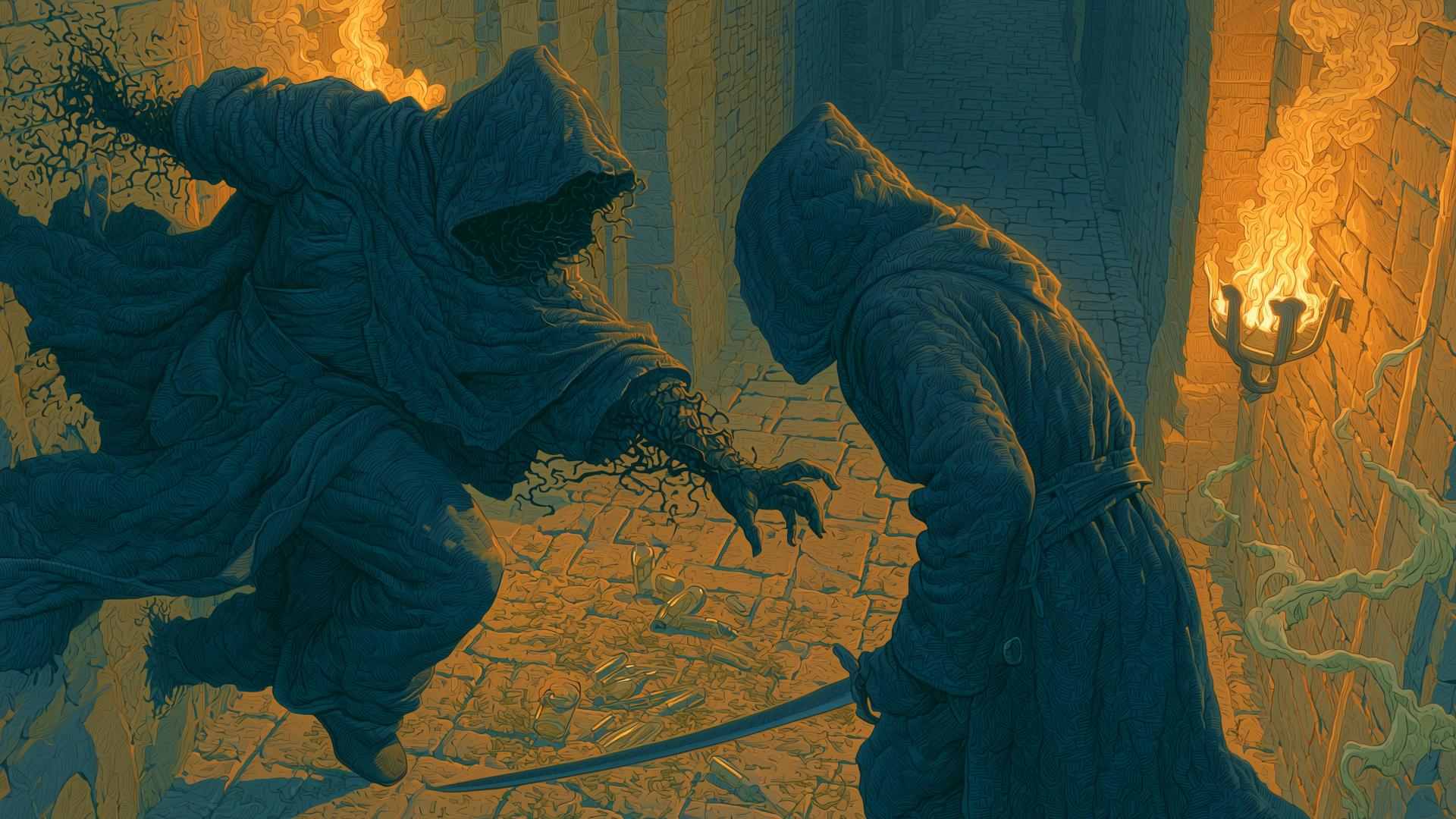
Achaea’s PvP runs on afflictions and cures. Each of the 21 classes carries roughly a hundred abilities, and most exist to put a specific problem on someone or take one off yourself. A Serpent works through venoms and wormholes, a Shaman curses you through a vodun doll, and a Sylvan calls the forest down on you.
The depth is in the bookkeeping. Watch what three afflictions do when they land in the right order:
You have been afflicted with anorexia.
You have been afflicted with slickness.
You have been afflicted with asthma.
Anorexia means you cannot eat a herb. Slickness means you cannot apply a salve. Asthma means you cannot smoke a pipe. Every route to curing yourself is now shut at once, and your opponent sequenced it deliberately to get there. Serious players write their own curing scripts to manage that priority queue, which means a duel is half a fight between two people and half a fight between two systems those people wrote. Text imposes no rendering ceiling on that kind of complexity, which is why it lives here and not in graphical games.
And everything else that piled up
Sailing. Buy a ship or crew someone else’s, then sail out past the coast to hunt sea monsters, run cargo between ports, or wait quietly for a merchant who is carrying something worth taking.
Mining. Open a mine, staff it, and pull out the raw material the entire crafting economy runs on. Mines get raided. Regional strongholds tax every mine inside their reach, which gives armies a reason to want them.
Dragonhood. At level 99 you can become a Greater Dragon in one of six colours. That unlocks 35 abilities spanning breath weapons, physical attacks, flight and travel between planes, and it works as an entire second class layered over the one you already have.
14 races and 21 classes, with multiclassing, so nobody is stuck forever with a decision they made in their first ten minutes.
How to try one
Achaea runs in a browser. Nothing to download, and it is free to start. It also runs through the Nexus client on iOS and Android, with your settings and scripts saved server-side so they follow you between devices.
New arrivals begin in a guided introduction covering movement, combat, trade and the command set before it turns you loose in Sapience. If you would rather read first, the beginner’s guide walks through character creation, the class list covers all 21 in detail, and the city-states page explains who you might end up swearing loyalty to.
Achaea is free to play. Most people who bounce off it do so inside the first hour. Most people who make it past the first week are still here a year later. Achaea is one of five worlds published by Iron Realms, if you want to see the rest of the genre.
Ready to play?
Common questions about MUDs
Patch notes, world events, and updates from Achaea - delivered to your inbox.
Name Please enter your name. Email Please enter a valid email address.Unsubscribe at any time via the link at the bottom of any email.