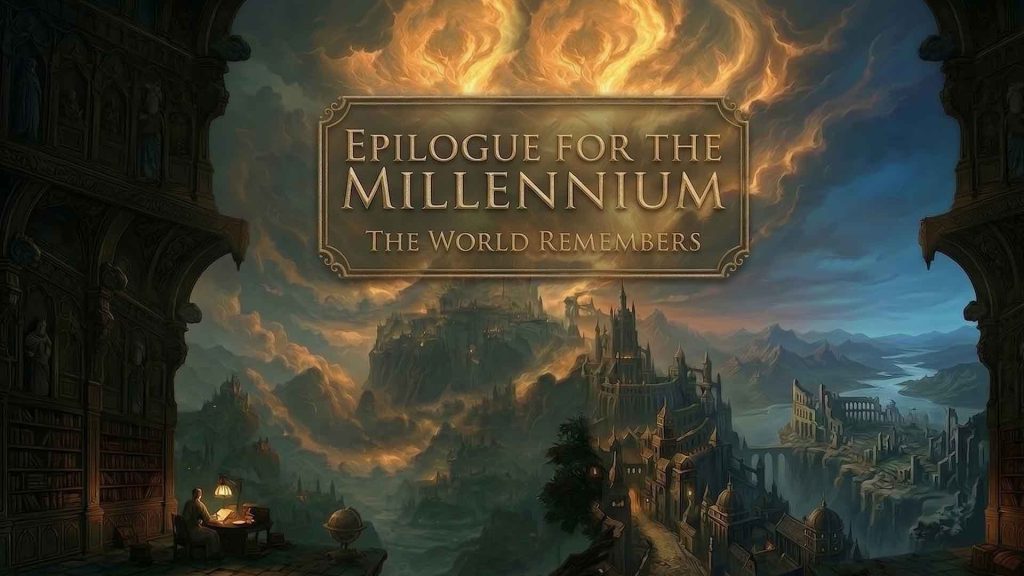
Epilogue for the Millennium
Dear Sister Alloa,
As the first frost of Mayan comes and the last of the warmth ebbs out of our northern home, I feel old. I pen this letter with the quill you gave to me for my twentieth name day, and only a month ago I celebrated – albeit not terribly excitedly – my three hundred and eightieth. Time has been mostly kind to me, and where others may tend gardens and groves, I have instead devoted my life to growing our library. I doubt you remember the two battered history books I began my adventure into chronicling with, but I do.
I do.
Now, as the Vault turns and we contemplate the arrival of a new millennium, my mind goes oft to Old Seleucar. My dream of a complete, faithful history will likely never be realised, but in the seeking and the searching, I have come to appreciate the lost mysteries and secrets for what they are. There is joy to be had in the unknown, and I sincerely believe that mystery is the genesis of discovery, and to know all there is to know harms the sense of wonder and awe.
A thousand years since the Empire’s fall and the world is hardly recognisable. Even my near four centuries have borne witness to incredible change and upheaval. I am often given to wonder what Nicator would make of the modern world, if he were alive to witness it. What of Catarin? Or her love Lucaine? Would they prosper in this modern incarnation of civilisation, or be pulled under by the tide of war and woe that seems to haunt us?
A question frequently posed by scholars is the source of Nicator’s success. Many hold up Nikolas as a paragon example of the ambition of mortality and the potential inherent in Maya’s offspring’s descendants. Of chaos bent to great wonders in place of great horrors. Others look to the Logos and chalk the Seleucar dynasty up to Divine Providence instituted by a meddling hand.
I was not yet born when the Logos went behind the Flame of Yggdrasil to do His long vigil. But I have studied every inch of every text on the matter, and I am, as all Gods-fearing men, grateful that we shelter in the palm of the benevolent Creator’s guiding hand. But that, of course, does not answer the question.
No Empire to rival Nicator’s has risen to supplant his legacy nor claim his crown. Civilisation peaked with Seleucar, it seems. Yet trickles of news from beyond the Flame of Achaea suggest that some, at least, are given to the attempt. War between Vertan and Kelstaad. Elemental disputes. Even within our own land of Achaea, the city-states have, with one exception, claimed the title Empire for themselves in conquest and battlefield dominance. And acquitted themselves with incredible acuity and skill in the doing and the taking. Why do none claim such provenance in the history books, then? Where are the Itinerant Bazaars laden with Ashtani antiques and Targossian treasures?
Is the answer so simple as to be the absence of Sarapis’ hand upon the tiller? I think not.
Rather I believe it to be the lack of common goal or purpose. In those thousand years, historians have noted an unprecedented volume of conflict among both mortal and Divine. One need only consult public records to learn of the copious disagreements that have escalated into disputes that in turn have escalated into armed conflicts, religious battles, and full-blown wars, often requiring divine resolution or significant compromise to settle.
The Pantheon, itself unrecognisable from the Divines recognised by Nicator (with several exceptions, of course), is often at the heart of these, even! None are strangers to an attempted gambit by Darkness or a seizure of land by Malevolence. Occultism, once a staple of Seleucarian professionals all across the Empire (admittedly, with some mistrust) is limited now only to Ashtan and the axis of Righteousness against Oblivion remains in full effect. The daughter of Aegis and Eris wreaks havoc with a single word, and the Sea and Sky shake the world with Their own unending grudge.
Hundreds of years of fractured history culminate in a thousand year mosaic. Another Seleucar has not risen, but is that such a bad thing? I look upon my hand-drawn maps and my mountainous piles of notes on the cultures and peoples I have met in my long years a’wandering, and I say “No, it is not.”
I see diversity and passion in every corner of the world. Fervour and devotion have not dimmed since the Empire’s Fall. Ambition has certainly not waned. Love, it is said, has faltered, but the Twin Halves are now whole. Blood writes much of the texts of history, and that blood is invariably spilled by those dedicated to ideals that are theirs, forged by their hands, their Gods, not by the ordainment of Logosian will catalysed by one fated to unite all as his own. In every city and village of this land have I dwelt for years at a time. And never have I felt them lacking in purpose or in spirit.
I’ve drunk with Dagon. Danced with Dryads. Argued with Harris and made bargains with Hutchings. I’ve eaten questionable food from Drogo and even partied at Blufest (twice!).
This is what history is. The people and the stories. The highs and lows. Clarity of purpose and ferocity of ambition in realising it.
And in that, I say that Achaea has rivalled Seleucar tenfold. Who else could emerge whole from the Age of Woe? Face two Black Waves. Fight Primordial Conduits. Witness the world sundering apart and a dozen Gods unmade by the Worldreaver. Survive Eternal Night. Repel leaden corruption. And more, too much more to tell in a simple letter. I encourage you to visit the library again in the near future. I will have some new stories to share.
Happy Year 1000, sister. Mourn not Seleucar, but celebrate the spark and breath of the present, and wonders yet to be conceived.
– Dinnis
Patch notes, world events, and updates from Achaea - delivered to your inbox.
Name Please enter your name. Email Please enter a valid email address.Unsubscribe at any time via the link at the bottom of any email.